
I recently visited Rausu, Japan, located on the northern tip of Hokkaido and home to the king of kelp, Saccharina japonica var. diabolica. I was traveling with a group of Americans to learn about Japan's sea urchin industry, and seaweed was an important part of the trip because it's the favorite food of sea urchins. Our group also visited Yamachu Foods in Hakodate, Hokkaido’s third largest city. Yamachu Foods is famous not only for its uni (sea urchin roe), but is also renowned for its dashi, a Japanese soup stock made from infusing water with dried seaweed, fish, or mushrooms. As it turns out, Rausu kelp makes the best dashi.
The company’s founder, a distinguished man in his 70s’ named Mr. Unae, served our group small cups of warm dashi along with samples of uni, abalone and other seafood delicacies. Many Americans don’t know what dashi is, let alone how to use it in cooking. And even though the founding of Maine Coast Sea Vegetables was inspired by a pot of miso soup made more delicious with wild Atlantic wakame umami, I realized I still had much to learn about dashi. The Yamachu Foods tasting session inspired me to learn more.
Dashi Umami
Dashi is most prized for delivering umami flavor. Umami is the fifth taste after sweet, sour, salty, and bitter. It was first described in 1908 by Kikunae Ikeda, a Japanese chemist. Ikeda studied chemistry in Germany from 1899 to 1901, and while there he experienced a hard-to-describe taste common to certain foods such as tomato, cheese, and meats that reminded him of home. When he returned to Japan, he realized that dashi held the same flavor, so he turned his chemical expertise to discovering what it was.

Kikunae Ikeda, born in 1864, uncovered the chemical basis of umami. Photograph from Wikipedia.
Eventually, Ikeda determined that it was glutamic acid from kombu seaweed that imparted the unique flavor, which he named umami. Glutamic acid is an amino acid that the body uses for protein synthesis, brain function, and metabolism. It’s a non-essential amino acid because the body can produce it and doesn’t require it from food. It’s also one of the most abundant amino acids in nature, but some foods are especially high in it.
A few years after Ikeda’s discovery, his disciple Shintaro Kodama identified inosinate in dried bonito (a mackerel-like fish related to tuna) as another umami substance. A third umami molecule, guanylate, was discovered in dried shiitake mushrooms by Akira Kuninake in 1957. Kuninake was the first to describe how combining glutamate with inosinate or guanylate had a synergistic effect that intensified umami taste. Glutamate, inosinate, and guanylate derived from kelp, fish, and mushrooms characterize the five main types of dashi.
What are the main types of Dashi?
· Kombu dashi is made from kombu kelp (often spelled konbu), with glutamate as the predominate umami substance. Kombu dashi is vegan friendly because it contains only water and seaweed. It also has the lightest and most subtle flavor.
· Shiitake dashi is made from dried shiitake mushrooms, with guanylate as the predominate umami substance. It often also contains kombu, which acts synergistically with shiitake to magnify the umami flavor.
· Katsuobushi dashi is made from bonito flakes, with inosinate as the dominant umami substance. Bonito imparts a smoky, fish-forward umami.
· Niboshi dashi is related to katsuobushi because it uses fish, but baby sardines, anchovies, or other fish are used instead of bonito.
· Awase dashi is the most common type and it contains both seaweed (kombu) and bonito (katsuobushi).

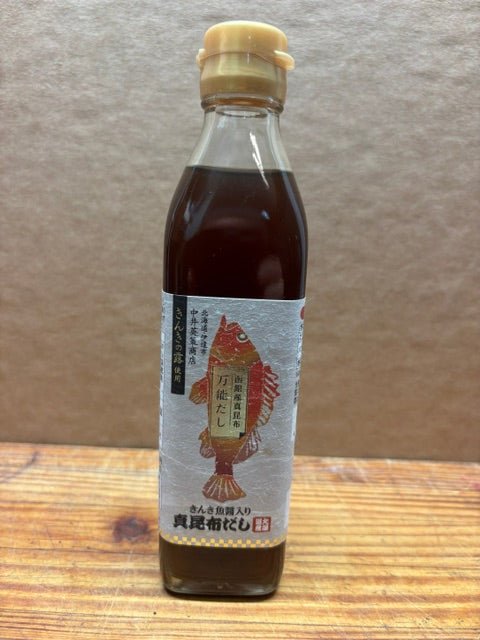
Makonbu dashi from Yamachu Foods is made with kombu kelp and rockfish sauce
Homemade dashi is a liquid stock but it can also be purchased in dried, concentrated forms as quick-dissolving granules, powders, or sachets. Most Japanese households used to make their own dashi and some still do, but many now prefer the dried forms for convenience. Monosodium glutamate (MSG) is another concentrated form of umami.
Are dashi glutamate and MSG the same?
MSG is glutamate with a sodium salt attached, and once it dissolves, it’s chemically indistinguishable from the naturally occurring glutamate found in foods such as kelp, tomatoes, and cheeses. MSG is made by fermenting starches or sugars from various plants such as sugar cane, corn, sugar beets, and cassava. Commercially produced MSG comes in a highly concentrated form that’s easy for manufacturers to add to foods and sauces.
The FDA regulates MSG under “generally recognized as safe” (GRAS) regulations, which means it has to be listed as a separate ingredient on food labels. Although many people report being sensitive to MSG, scientists have been unable to consistently trigger reactions when people who say they are sensitive are given either MSG or a placebo. It’s possible that some people blame their symptoms on MSG when gluten is actually the culprit. Glutamate is not at all related to gluten, but soy sauce and other foods may contain both ingredients. The FDA website Questions and Answers on Monosodium glutamate (MSG) has more information on this topic.
We do find it interesting, though, that many of our MSG-sensitive customers say they use umami-rich sea vegetables such as Atlantic kombu and Atlantic wakame to substitute for MSG without experiencing sensitivity. We see this as yet more evidence that whole natural foods are better for the body than highly processed replacements such as MSG.
How is dashi made?
Yamachu Foods has a factory kitchen full of gleaming stainless-steel equipment for making dashi, which Mr. Unae said was a $1 million investment. Fortunately, dashi can also be easily made at home in 30 minutes or less by simmering or infusing water with one or any combination of the three main umami foods: seaweed, certain kinds of fish, or shiitake mushrooms. These are always used in dried forms because their umami is much more concentrated than in their fresh forms. Boiling water should be avoided during dashi preparation because it can bring out an undesirable bitterness.

Yamachu Foods dashi kitchen
The basic recipe is to soak 10 grams of kombu kelp, or one strip, in four cups of fresh water at room temperature for about 30 minutes and then heating it to just below boiling in an open pan. Remove the pan from heat as soon as the first boiling bubbles appear, then quickly remove the kombu from the broth. The kelp can be discarded or eaten. Dashi can also be made using a cold-brew method. Add a strip of kombu about 4-6 inches long to 3 cups of cold water, refrigerate for 3 to 10 hours, and remove the kombu. This creates a milder but still delicious dashi.
Can any kind of seaweed make dashi?
In Japan, kombu kelp is almost exclusively used to make kombu dashi because it contains the largest percentage of free glutamate. The three primary kombu species are Ma-kombu Saccharina japonica, Rausu-kombu Saccharina diabolica, and Rishiri-kombu Saccharina ochotensis. Most of this kombu is harvested from Hokkaido, but it’s possible to purchase these varieties in the US. US cooks can also use seaweed grown closer to home to make dashi.

Prized as the king of kelp, Rausu kelp from Hokkaido Japan makes the best konbu dashi
Can dashi be made from North American sea vegetables?
Although kombu kelp contains more free glutamate than any other seaweed, other species such as laver, sugar kelp, and dulse all contain appreciable amounts. A 2012 research paper looked at whether sugar kelp, dulse, and graceful red weed (Gracilaria verrucosa) made acceptable dashi (Mouritsen et al, Seaweeds for umami flavor in the New Nordic Cuisine). The authors made dashi from these species using a sous-vide technique and compared it to kombu dashi. Sous-vide is a technique where food is vacuum-sealed in a plastic bag and cooked in a temperature-controlled bath. Ten grams of each seaweed was cooked sous-vide style in 500mls of tap water for 45 minutes, and sophisticated laboratory equipment was then used to analyze the broth for amino acid content. Each broth was also rated for flavor by a panel of five expert chefs.

dashi made from dried whole-leaf dulse has a complex flavor profile, especially when it's made from aged dulse
Dulse emerged as the clear favorite. Although sugar kelp made an acceptable dashi broth, it was somewhat more viscous with less glutamate compared to the other broths. It should be noted, however, that the researchers used farmed sugar kelp. We've found that wild sugar kelp fronds are generally thicker and more flavorful than those from farmed kelp. Gracilaria dashi contained only slightly more glutamate than sugar kelp and produced the most disappointing dashi. Wild, Icelandic dulse dashi had about twice as much glutamate as Gracilaria, while farmed Danish dulse dashi had four times more glutamate than wild dulse.
Moreover, the authors found that aged dulse made better dashi than newer dulse because the fronds had more precipitated glutamate and other salts on their surfaces. This is often true with other sea vegetables as well, such as sugar kelp. Finally, the authors found dulse dashi to be sweeter and more complex than traditional konbu dashi, probably because it released more of the sweet amino acids alanine, proline, glycine and serine.
Alaria (winged kelp or Atlantic wakame) is another native North American seaweed that makes excellent dashi. Alaria dashi is more like traditional kombu dashi and it has a lower iodine content than sugar kelp, which might be a consideration for those with sensitive thyroids. Laver also makes good dashi. In addition to containing rather large amounts of free glutamate, laver is unique among seaweeds for also containing inosinate and guanylate for synergistic umami.

Whole leaf Alaria from Maine Coast Sea Vegetables makes an excellent dashi
How do I use dashi in recipes?
Dulse dashi’s complex flavor profile encouraged the researchers to experiment with some interesting recipes, including ice cream with dulse. Instead of making dulse dashi from water, they made it by steeping 12 grams of dulse in 2½ cups of milk overnight in the refrigerator. The dulse was then strained from the milk and pureed to be added later in the process. Their recipe used about 3 tablespoons of sugar and ¼ cup of trimoline (inverted sugar syrup) along with ½ cup of heavy cream and the pureed dulse, but other proportions would probably work. The color of the dulse ice cream was described as a pleasing light mauve, and the flavor as delicate, light, and floral. Tasters compared it to Japanese green tea ice cream. We suggest using MCSV dulse flakes or granules if you try making this recipe at home.
Kombu dashi is more traditionally used as the starting liquid to gently dissolve miso paste for miso soup, or as a base for ramen and udon noodle soups. Another traditional use is as a simmer broth for Nabemono (hot pot) or Nimono, a Japanese cooking method of simmering ingredients like vegetables, meat, or fish in a flavorful broth. A more Western approach is to substitute 1-2 cups of kombu dashi for water when cooking grains or beans. Not only does this add flavor, it's also said to improve the digestibility of legumes.
Ultimately, dashi is a tremendously versatile broth that adds umami flavor to any recipe calling for liquid. It’s best used when fresh and it should always be kept refrigerated or frozen after being made because it quickly spoils at room temperature. Fortunately, it doesn’t take much effort to make a fresh batch, as long as you have some dried kombu, Alaria, or dulse in the larder. To ensure that, of course, you have Maine Coast Sea Vegetables!